

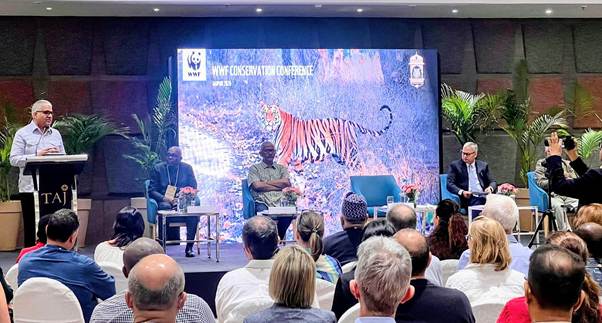
Union Environment Minister inaugurates WWF Global Conservation Conference at Jaipur (Rajasthan)


Forest and Climate Change minister calls for Global Action on Conservation and Coexistence by Involving Local Communities
Union Minister for Environment, Forest and Climate Change, Bhupender Yadav, today inaugurated the Global Conservation Conference of the World Wide Fund for Nature (WWF) at Jaipur. Dignitaries present during the inauguration ceremony included Additional Director General (Wildlife), MoEFCC, Ramesh Pandey; Head of Forest Force and Principal Chief Conservator of Forest, Government of Rajasthan, Arijit Banerjee; Chief Conservation Officer at WWF-International, Daudi Samba; and, CEO of WWF-India, Ravi Singh.
Addressing representatives from more than 100 countries, the Minister emphasised the need to act on conservation and coexistence, reconnect as a community, take confidence from the progress being made, and build a shared sense of hope and direction. Yadav shared the vision of Prime Minister Narendra Modi in the field of wildlife conservation and mentioned how the number of protected areas have gone up from around 750 to more than 1000 in the last decade. Similarly, the number of tiger reserves rose from 47 to 58 and elephant reserves from 30 to 33, while the number of Ramsar sites has gone up from 24 to 101 in the same period. He further narrated the success of Cheetah reintroduction in India, under the visionary leadership of the Prime Minister.
Yadav informed the gathering that India’s commitment to species conservation is both constitutional and cultural, rooted in a worldview that long predates modern protected-area law. India has built a substantial framework in its Constitution that makes protecting wildlife both a State directive and a citizen’s duty, yet this formal architecture rests on a deeper ethos. India is also a party to CITES, CMS, CBD and the Ramsar Convention, and its recovery of tigers, elephants, rhinos and Asiatic lions shows what sustained political will can achieve.
The Minister also mentioned how scientific research and monitoring mechanisms in the country have led to conservation successes. He underlined the pan-India population estimation of species such as tiger, elephant, dolphin, lion and snow leopard have provided insights for habitat improvement, securing corridors and taking landscape approach in megafaunal species. He also narrated the success of conservation breeding of Great India Bustard (GIB) in Rajasthan and community led protection and conservation of sacred groves called Oran, helping in land degradation neutrality.
Yadav emphasized the need of conservation of grasslands along with woodlands and wetlands. He shared India’s approach towards conservation of grassland-based mega herbivores and informed the gathering about the ongoing conservation programmes on one-horned rhinoceros and the wild water buffalo. He concluded his address by giving a call to the wildlife conservationists to come together not only to reflect, but to move forward, learn from what works, and turn it into action.